40 Puffs Per Day, Snap, Crackle & Pop
TIME IMMORTAL THE CRISIS OF AGE provides a new insight into the age of the Universe and examines redshift dynamics.
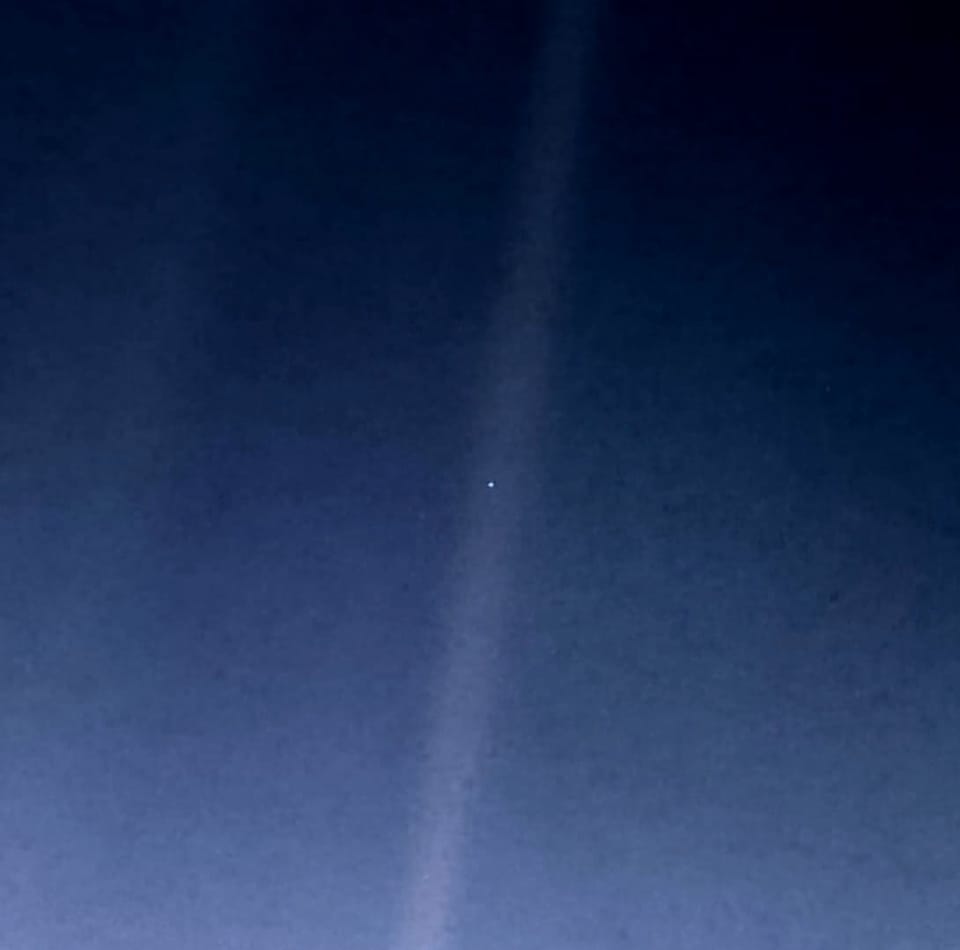
Gravitational fields are interactive and can never be zero. The Voyager spacecraft is a perfect example because although its considered to be in deep space, it is still buffeted by gravitational fields of our sun and our solar system, and as minute as we may think these are, it requires forty puffs of its hydrazine jets every day to correct its orientation. Whilst there are other influences on the craft, nevertheless Voyager is still in still a solar freefall despite being nearly tweny-six billion kilometres away and, although Voyager 1 is travelling at a whopping 61,000 kph, it is actually slowing because of the sun's gravity, trading its kinetic energy for potential energy.
The key point is that the Voyager spacecrafts never truly "escape" the Sun's gravitational field entirely, because the field has infinite range.
When scientists say a spacecraft has "escape velocity," they mean it has enough speed to reach an infinite distance from the central body (the Sun) without running out of kinetic energy. The mathematical definition of "zero gravitational potential energy" is assigned to the state of being infinitely far away. Yet? The Voyagers can never reach infintity and so will never reach a distance where the Sun's gravitational field is truly zero, but they are guaranteed to reach the theoretical "infinity" point where eventually their interersection with another gravitational field becomes more dominant, as is the case of Voyager 2 when it will travel close to the Ross 248 Red Dwarf, puffing all along the way if it can.
Voyager shows two things:
Firstly – Where does the potential energy go? Well, it is simply stored in the system as the increasing separation distance between the spacecraft and the Sun. The energy is never destroyed: It exists as potential energy, while the kinetic energy asymptotically approaches a final value above zero.
Secondly, gravitational fields simply don't stop. One field's influence may dwidle to another's as it becomes influenced by a third. Seemingly complex the trajectory of such motion may appear, thermodynamically it's much more straightforward – the potential energy can't just disappear. It becomes part of The System.
So what is The System? It is the total balance ledger of the Cosmos: The Energy at foundation is preserved - not one joule created or one joule lost since The Big bang, just converted from the big spending kinetic energy to the spend-thrift potential. That's why we say the Universe is a Closed Energy System: Nothing extra gets in and nothing extra gets out.
We represent this concept by the concept of E{k} + E{p} = 0 and we must clarify something. We are not saying the Cosmos has no energy. Or even if we tot up the kinetic energy and the potential energy then its zero: What we are saying is that the Cosmic Ledger is Zero - that the bling chaotic and dynamic kinetic energy is balanced by the stately ordered and miserly potential energy.
Our Supplement One examines this concept and the intimate matrimony of kinetic and potential energies are played off in the only game in the town of the Cosmos – Gravity – and how this affects destiny... Is the Cosmos really 13.8Bn years old? Could it be significantlly older, which might explain how the very young Universe was metal rich at just five hundred million years, seemingly defying our knowledge of the thermonuclear process. Using our results from our examination of The Fornax Fisuure, we explore the 4TH Order of spacetime - The Snap, but without the Crackle or the Pop!
Download The Crisis of Age and immerse yourself in a mathematical rollercoaster to a dramatic and surprsing conclusion
d.o.i 10.5281/zenodo.18358158
CERN, European Organization for Nuclear Research, 1211 Genève 23, SWITZERLAND