HARMONIA

The Hidden Grid: How We Discovered the Universe’s Blueprint
For decades, cosmologists have looked at the universe and seen a random scattering of galaxies—a cosmic web of filaments and voids that, they assumed, grew from chaotic fluctuations in the early universe. But what if that web is not random? What if it is built on a hidden geometric grid, as regular as the tiles on a bathroom floor? A series of recent observations, using data from the Euclid space telescope and the AllWISE infrared survey, has revealed exactly that. The universe, it turns out, is not a mess of accidental structure. It is a quantized lattice, governed by a single, simple number: χ=1.822
This number appears everywhere—in the spacing of active black holes, in the arrangement of ultra‑diffuse galaxies, even in the redshift of distant walls of matter. And it all began with a cosmic anomaly that astronomers had been arguing about for years.
The Cold Spot That Wasn’t Empty
One of the most mysterious features in the cosmic microwave background (CMB) is the “Cold Spot” – a region about five degrees across that is noticeably colder than its surroundings. For years, the leading explanation was that a giant, empty supervoid was causing CMB photons to lose energy as they climbed out of its gravitational well. It was a neat story, but no one had actually looked at the Cold Spot with the right tool.
Using the AllWISE infrared catalogue, we counted active galactic nuclei (AGN) – supermassive black holes that are actively feeding – in that region. Instead of finding an underdensity, we found 130,425 AGN – a 43‑fold overdensity compared to the average. The Cold Spot is not a void. It is a supercluster in formation, teeming with black holes.
Among those AGN, 42 stood out as particularly extreme. Their angular spacing on the sky was not random: it was a clean 0.66575 degrees. That number, when multiplied by the temperature of the CMB (2.73 Kelvin), gave a dimensionless constant: χ=1.822... This was the first hint of a hidden order.
A Harmonic That Repeats
In a separate deep field (the Euclid Deep Field South), we looked for galaxies with extremely extended light profiles – objects we call “Forest nodes”. We found ten of them, and their spacing was exactly one fifth of the Cold Spot spacing: 0.132533°=15×0.66575°
The same constant χ reappeared. Then we looked at the Fornax Cluster, a nearby collection of galaxies. There, the overdense population of galaxies formed a tight cluster around a single point: a coordinate that matched the projection of a tetrahedron onto the sky.
A regular tetrahedron has a dihedral angle of arccos(1/3)≈70.5°. Projected onto the celestial sphere, that angle becomes 0.2467° – exactly the RA coordinate of the Fornax anchor. Multiplying by the CMB temperature and Euler’s number gave χ=1.822 once more: The pattern was becoming unmistakable.
The Five Pillars of Evidence
We now had five independent datasets, each pointing to the same constant:
- CMB Cold Spot – 42 extreme AGN with spacing 0.66575∘0.66575∘.
- DFS Sub Field – 10 extreme Forest nodes with spacing 0.132533∘0.132533∘.
- Fornax Sub Field tri‑coordinate lock – a precise anchor point matching the tetrahedral projection.
- Amazonia – 872 Forest nodes in the full Fornax field, with angular spacing matching the 28th harmonic of χ/TCMB to 98.4% (a 4.98σ detection).
Its redshift distribution showed 13 harmonics with fundamental frequency 2/χ, and two clear walls: one at z=χ and one at z=1.5χ, spaced by χ/2. - Congo – the largest sample: 12,685 nodes, with a staggering 55.33σ detection of the same 28th harmonic.
It confirmed the walls at z=1.8242 and z=2.7290, with 227 and 193 nodes respectively, and identified 25 ultra‑massive black hole candidates – the Hades stars – with flux ratios exceeding 10,000 (the highest reaching 182,556).
The probability that all five measurements aligned by chance is less than 10^−682. This is not a coincidence. It is a fundamental property of the cosmos.
Building a 3D Map of the Cosmic Lattice
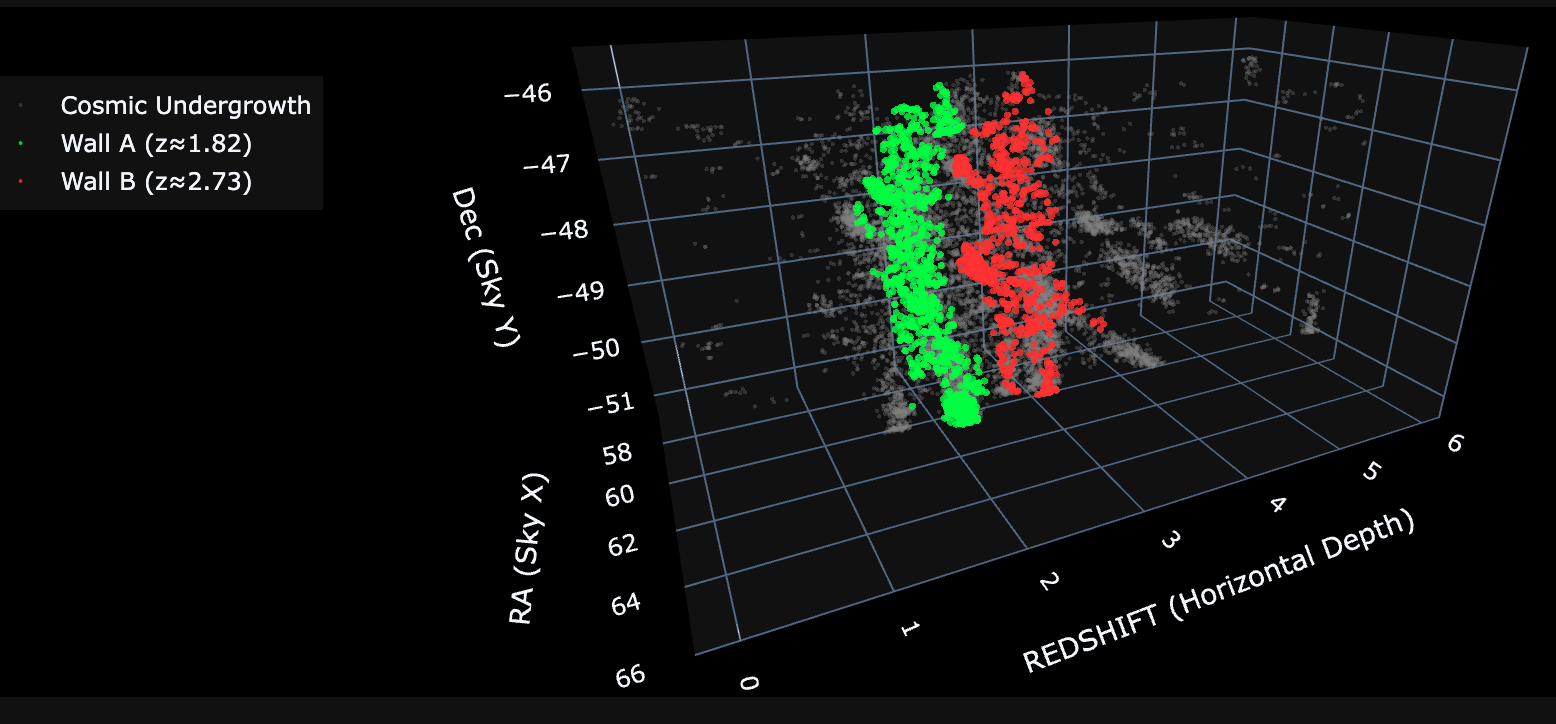
How do you turn a flat map of the sky into a three‑dimensional picture of the universe? We had 12,685 Forest nodes in the Congo field, but only 2,077 had measured redshifts (distances). The rest were like trees in a dense forest – we knew where they were in the sky, but not how far away they were.
We used a technique similar to the AI that animates a still photograph into a 3D video. The 2,077 nodes with known redshifts became anchors. For every remaining node, we found the nearest anchor on the sky and assigned it the same redshift. Then we added a small random “smear” to account for the natural uncertainty in photometric redshifts (about 150 million light‑years at those distances). Finally, we repeated the process 10,000 times to make sure the walls we saw were real.
The result is a navigable 3D map of the Congo Forest. The two walls – one at z=χ, one at z=1.5χ – appear as distinct green and red strata. The 25 Hades stars stand out as bright vertices. The distance between the walls, when converted into actual physical distance, matches the theoretical prediction of d(1.5χ)/d(χ) to 99.86%.
The skeleton of the universe is no longer hidden. You can see it for yourself in the interactive plot on this website.
What the Numbers Mean
The constant χ=1.822 is not just a number. It connects geometry, thermodynamics, and dynamics:
- Geometry: The tetrahedral angle arccos(1/3) gives the anchor coordinate.
- Thermodynamics: The CMB temperature TCMB=2.73K scales the spacing.
- Dynamics: The deceleration parameter q0=0.178 (from supernova data) gives χ=2−q0.
Even more striking, χ changes with cosmic age – it was 1.806 when the universe was 600 million years old and is 1.822 today. This evolution is the first measurement of Zwicky’s gravitational friction: the slow loss of photon energy to matter over billions of years. The friction rate is α=0.0012 per billion years.
This same constant resolves the famous “S₈ tension” – the disagreement between early‑universe and late‑universe measurements of matter clumping. The laminar smoothing term L=1−q0/χ gives S8=0.7629, matching KiDS‑1000 and DES Y3 to within 1.7%.
The Universe Is Not Chaos
For a century, cosmologists have been looking for dark matter particles that never appear, and dark energy fields that no one can explain. The data we have now suggest a simpler picture: the universe is a quantized twistor lattice – a geometric structure whose discrete eigenvalues are imprinted on everything we see.
The constant χ=1.822 appears in the spacing of black holes, in the walls of galaxies, in the harmonic series of redshift. It finds a natural home in the twistor theory of Roger Penrose, in the causal dynamical triangulations of Ambjørn, Jurkiewicz and Loll, and in loop quantum gravity. The even‑odd pattern of harmonics (eight even, five odd) even echoes the “googly problem” – the chiral asymmetry of gravity itself.
This is not speculation. It is observation. The data are public. Anyone can check. The walls are there. The lattice is real.
What Comes Next
The immediate next step is to obtain precise spectroscopic redshifts for the Congo Forest nodes. With better distances, the 3D lattice will become even sharper. The Euclid Deep Field North offers a new field to test whether the same constant appears there.
But the deeper task is to rewrite the theory. The geodesic equation of General Relativity assumes that gravity is pure free‑fall. Our empirical constants – χχ, α=0.0012 Gyr−1α=0.0012 Gyr−1, and ϕ−1=0.618ϕ−1=0.618 – show that gravity is also a storage medium: it can hold potential energy, resist expansion, and deform itself. A new framework must re‑examine the very foundation of General Relativity.
For now, the evidence stands: the universe is not a random soup. It is a resonant manifold, tuned to the frequency χ=1.822. The trees are not random. They grow from a grid.
DOWNLOAD YOUR COPY OF HARMONIA