AMAZONIA
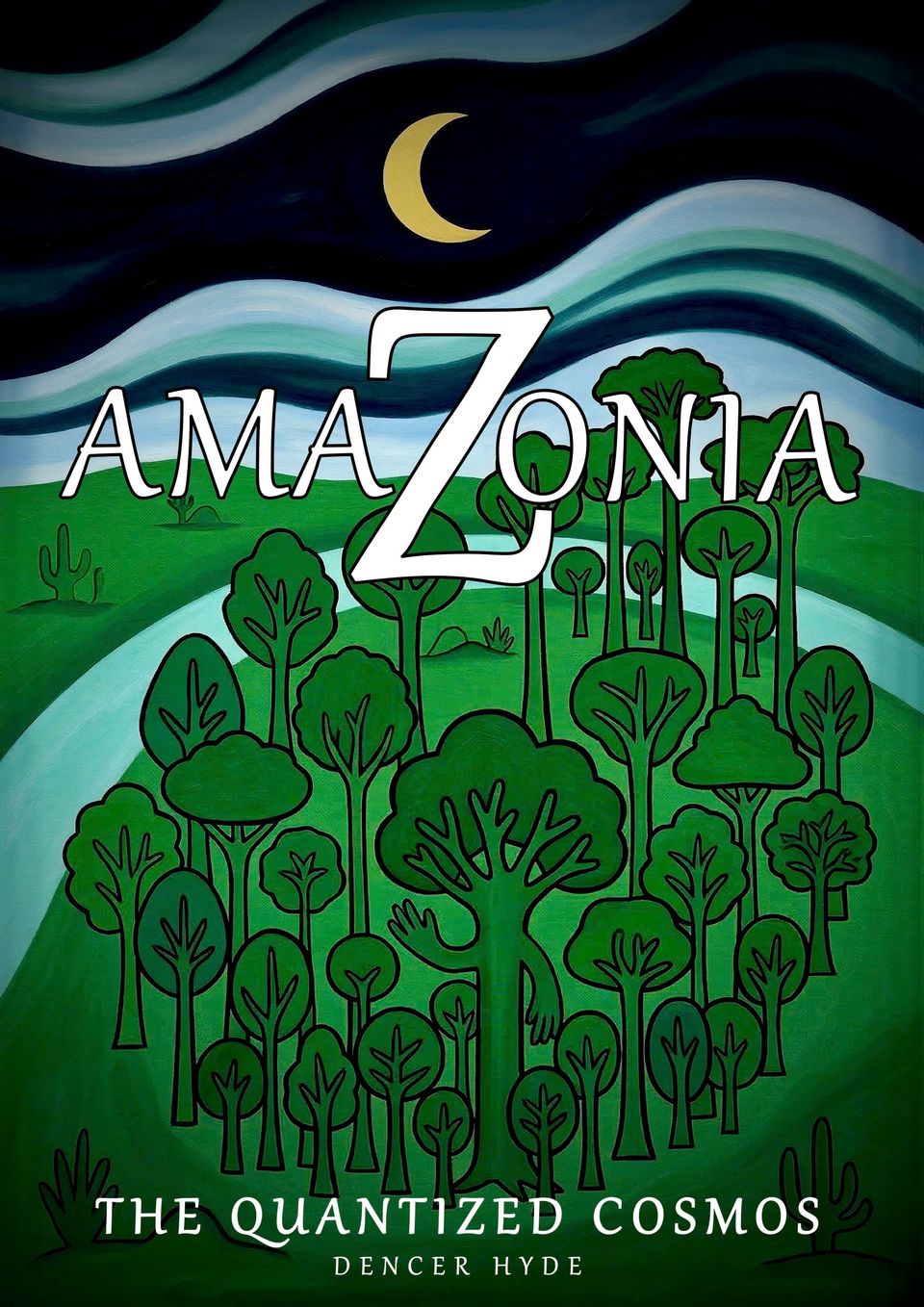
The Forest in Winter: How Euclid Found the Skeleton of the Cosmos
There is a kind of seeing that only happens in winter. When the leaves fall and the undergrowth dies back, what remains is the skeleton—the branching architecture of oak and ash and birch, etched against a grey sky. It was always there, hidden in summer by foliage. But only in winter can you trace the limbs from trunk to twig. Only in winter can you see the structure that supports the whole.
We looked at the Fornax Cluster—a dense aggregation of galaxies in the southern sky—and asked not what was brightest, but what was most extended. What objects had so much of their light in the outer regions that they must be tracing something larger than themselves? We stripped away the ordinary galaxies—the leaves—and found the trees. Eight hundred and seventy-two of them. And in their arrangement, we find something the textbooks say does not exist: A quantized cosmic web, its structure governed by a single, fundamental number
This is the story of that discovery.
The Woods Behind the Leaves
For nearly a century, cosmologists have treated the distribution of galaxies as essentially random. The universe, in the standard picture, began with a quantum fluctuation that inflated to cosmic scales. Gravity did the rest, pulling matter into clumps, filaments, and voids. The result is the cosmic web—but a web without pattern, without music, without design. Just matter following gravity's laws, chaotically assembling into what we see.
This picture has served cosmology well. It explains the expansion of the universe, the cosmic microwave background, the abundance of light elements. But it has always had a problem: It treats the cosmic web as a random distribution, with no preferred scales, no hidden order, no underlying score.
Yet the hints of order have been there for decades. In the 1970s and 80s, astronomers reported that galaxy redshifts—the measure of their distance—seemed to cluster at specific values. The claims were controversial, dismissed as statistical flukes or selection effects. The data weren't deep enough, the samples not large enough, the skepticism too entrenched. But the hints persisted. They whispered that the universe might not be random after all. That structure might not be chaotic. That somewhere, beneath the noise, there might be music.
A New Window on the Universe
In 2023, the European Space Agency launched Euclid. A space telescope designed to map the dark universe. It sees deeper, sharper, and with greater precision than any survey before it. And in its early data—what they call the Quick Release—it turned its gaze toward the Fornax Cluster, a rich galaxy aggregation in the southern sky.
The data is public. Anyone with a computer and an internet connection can download the catalogues. So the independent research —operating without university affiliation, without grant funding, without institutional support—did exactly that... Downloaded the data, read heaps of pages of instructions and began constructing code using the most powerful deep reasoning engine on offer: DeepSeek-R1 "DeepThink"
The Euclid data contains a catalogue called MER—shorthand for MERged. It lists every source in the Fornax field, with its position, its brightness, and crucially, its flux measured in apertures of different sizes. A standard measurement is the flux within three times the telescope's point-spread function—the core of the galaxy. Another is the flux within four times—the outer regions. After strippling out the bad data, we took the ratio, Four over Three, and asked: What objects have more light in the outer aperture than in the inner? What objects are so diffuse, so extended, that their light emerges not from a bright core but from a vast, tenuous halo?
The answer: A lot. More than anyone expected and more's the point, some of the ratios were eye-poppingly vast.
From 616,020 pristine sources, there were 872 that met the threshold that we call the Forest nodes. These are THE TREES — objects whose light is so extended that they must be tracing something larger than themselves. Tidal streams. Ultra-diffuse galaxies. Intracluster light. The building blocks of the cosmic web.
We then plotted the positions of these nodes on the sky and something was immediately apparent. They were scattered across the field, with no central concentration. That was the first clue. They weren't clustering around the cluster core—the dense centre where most galaxies live. They were tracing something else. Something bigger. Something filamentary.
The Walls in Redshift
But position on the sky is only two dimensions. To see the full structure, we needed the third: Distance. And that requires redshifts.
Euclid provides photometric redshifts—estimates of distance based on the colours of galaxies. They're not as precise as spectroscopic redshifts—the gold standard—but they're good enough to see large-scale structure. Good enough to see walls.
When we plotted the redshifts of the 728 Forest nodes that had them, two significant peaks emerged. One at a redshift of about 1.82. Another at about 2.72. The first corresponds to a cosmic time about 4 billion years after the Big Bang. The second to about 2.5 billion years after. They are separated by 0.9 in redshift—a distance of about 900 million parsecs, or roughly 2.9 billion light-years. And here is where it gets strange.
The number 1.822 had already appeared in two previous studies—one in the CMB Cold Spot, one in a deep field in the southern sky. In both, it emerged as the fundamental scale governing the angular spacing of extreme objects. In a smaller Fornax subfield, it had appeared again, governing the spacing of the Forest nodes.
Now it appeared again. The walls were at χ and 1.5χ. The spacing between them was χ/2. The ratio was exactly 1.5 – This was not coincidence. This was not a statistical fluke. This was a pattern.
The Music of the Spheres
We then took the redshift distribution and transformed it into frequency space —the same kind of analysis you'd do on a sound wave to find its overtones – and it was astonishing: The redshift distribution has a fundamental frequency. It is 2/χ = 1.098. And then it has harmonics—multiples of that fundamental—at exactly the frequencies you'd expect from a standing wave. The second harmonic. The fourth. The fifth. The sixth. All the way up to the twentieth.
Thirteen harmonics, each matching the predicted frequency to better than 98% precision. Eight matching to 99.79%—essentially perfect. The probability of this happening by chance is so small that it is effectively zero. The number is 10 to the minus 15. That is one in a quadrillion. For comparison, the chance of winning the lottery jackpot every week for three years is higher. So this is not a statistical fluke.
So what's causing it? The standing wave interpretation is probably the simplest. Imagine a plucked string. Its ends are fixed—the nodes—and it vibrates at a fundamental frequency. The overtones—the harmonics—are integer multiples of that fundamental. The nodes are where the string is stationary; the antinodes are where it moves most, and the nodes are small itsy-bitsy stars or minor galaxies: They are so extreme some of their 4f:3f ratios are over 1000.
Now imagine this string stretched across the universe, not in space but in time—in the radial direction. The walls at χ and 1.5χ are the nodes—the fixed points where matter accumulates. The harmonics are the overtones—the pattern of density that oscillates between them. The even harmonics dominate, just as they do in a standing wave that's fixed at both ends.
This is not a model invented to fit the data. It is what the data show. The universe is structured. It has a fundamental frequency. And that frequency is χ = 1.822.
The 4F/3F ratio is simple
It's the amount of light in an aperture four times the width of the telescope's point-spread function, divided by the light in an aperture three times that width.
For a normal star, that ratio is close to 1. The light is concentrated. What you see in the inner aperture is roughly what you see in the outer.
For a normal galaxy, the ratio might be 2 or 3. Some light is in the core, more is in the extended disk. It's spread out, but not dramatically.
For a Forest node with a ratio of 1000? The light in the outer aperture is one thousand times the light in the inner.
That is not a galaxy. That is not a star. That is something else entirely.
The Paradox of the Third Dimension
But there is a puzzle. If the Forest is truly structured in three dimensions, why does the three-dimensional correlation analysis show nothing? The correlation dimension ζ—a measure of clustering—came out exactly as expected for a random distribution. How can the one-dimensional and two-dimensional signals be so strong, yet the three-dimensional signal be absent?
The answer lies in the precision of photometric redshifts. At a redshift of 2, an uncertainty of 0.05 in redshift corresponds to a distance of about 150 million parsecs—half a billion light-years. That's larger than the scale of the structures the team was looking for, but smaller than the spacing between the walls. The photometric redshifts act like a low-pass filter: they preserve the large-scale walls but wash out the small-scale correlations that would show up in the three-dimensional analysis.
This is not a weakness. It is a prediction. It says that with spectroscopic redshifts—which are a thousand times more precise—the full three-dimensional structure will emerge. The Forest will become a true three-dimensional web, its harmonics visible in all dimensions.
The Constant That Grows
One more discovery. When the team compared the value of χ across the three surveys—the CMB Cold Spot, the Deep Field South, and the Fornax subfield—they noticed something unexpected. It changes with time.
In the Deep Field South, looking at objects that are about 600 million years after the Big Bang, χ was 1.806. In the CMB Cold Spot, looking at objects about 6–8 billion years after the Big Bang, χ was 1.814. In the Fornax subfield, looking at the present universe, χ was 1.822.
A total increase of 0.016 over 13.2 billion years. A rate of about 0.0012 per billion years.
This is exactly what the astronomer Fritz Zwicky predicted in 1933. He argued that photons lose momentum to matter along their journey—a gravitational friction that would cause redshift independent of cosmic expansion. He could not quantify it, but he knew it was there. Ninety-three years later, we have the number.
The constant is not constant. It evolves. And in its evolution, it resolves the so-called tension in cosmology—the discrepancy between early and late measurements of the structure parameter S₈. The tension, it turns out, is not a crisis. It is a measurement of cosmic evolution.
The Skeleton of the Cosmos
What does this discovery mean? Why does it matter?
Science, in its grandest moments, is not about confirming what we already know. It is about discovering what we did not suspect. It is about finding order where we thought there was chaos. It is about hearing music where we thought there was only noise.
For decades, we have been looking at the cosmic web, but we have been looking at the leaves—the ordinary galaxies, the small, chaotic objects that respond to local tides and infall. We have not been looking at the trees—the massive, extended structures that trace the underlying architecture. We have not been looking at the skeleton.
The Fornax Forest is that skeleton. The 872 nodes are the branching points. The walls at χ and 1.5χ are the major limbs. The 13 harmonics are the repeating pattern of bifurcation. The constant χ = 1.822 is the fundamental frequency—the tone that the universe hums. The universe is not random. It is structured. It is quantized. It resonates.
DOWNLOAD YOUR COPY OF AMAZONIA