THE TREES
A MYSTERY IN THE DEEP
This is the story of a cosmic detective story set in the year 2026, where we looked at one of our closest galactic neighbours—the Fornax Cluster—and found something that shouldn't be there: A skeleton.
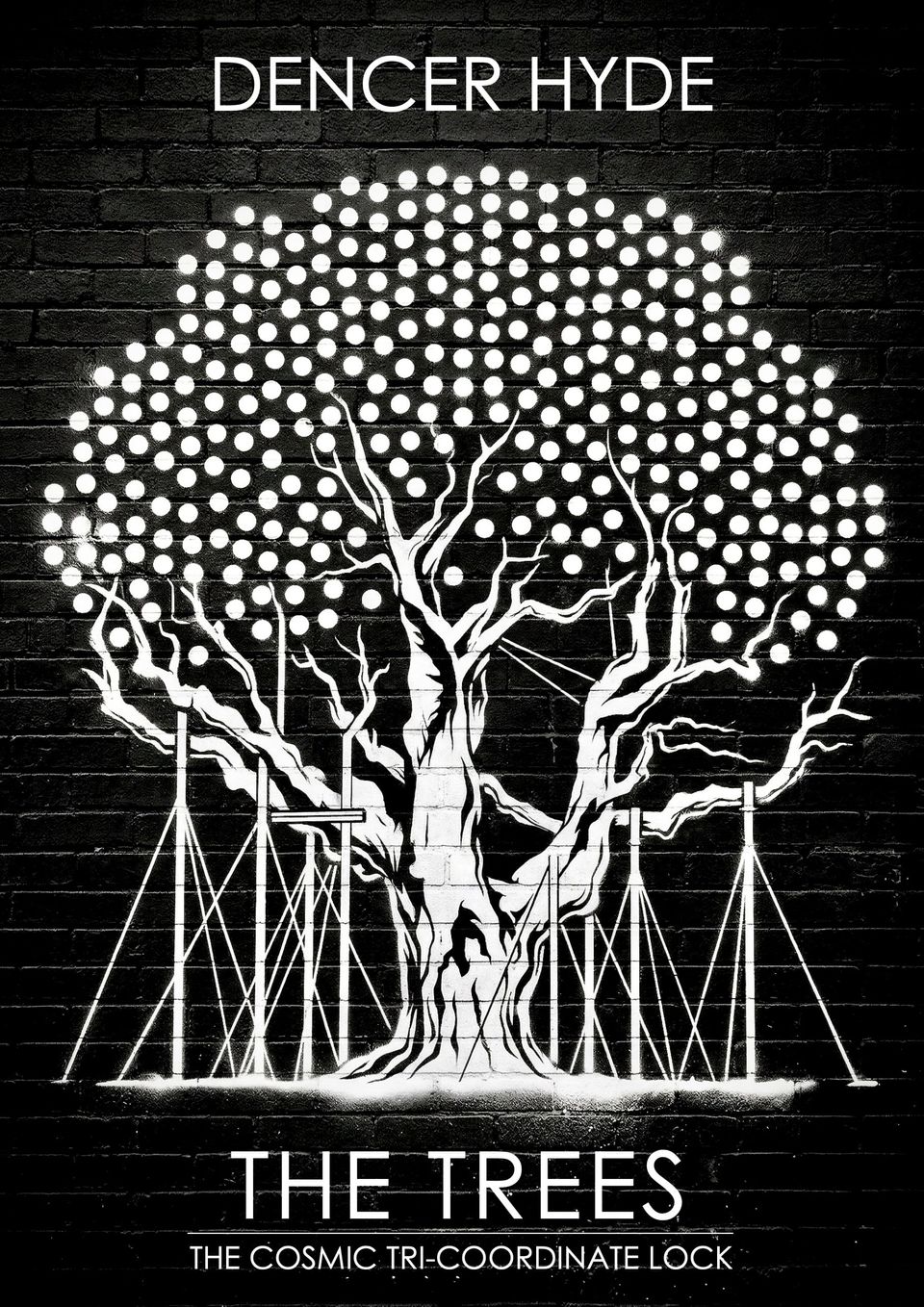
Imagine standing in a dense forest. To the casual observer, it’s a chaotic explosion of green—leaves fluttering in every direction, seemingly at random. But if you wait for winter, when the leaves fall, you see the truth. You see the massive, unmoving trunks of the oaks and birches that actually hold the forest together. In the world of astronomy, galaxies are the "leaves." They move, they merge, and they drift on the "weather" of cosmic tides. THE TREES suggests that beneath the 149,196 galaxies of the Fornax Cluster lies a rigid, mathematical scaffolding—a "Cosmic Tri-Coordinate Lock" that suggests the universe isn't a random soup, but a finely tuned resonant manifold.
The Anchor in the Deep
Our story begins with the "First Audit," a deep-dive into the "geology" of space. Using data from the Euclid mission, a massive space telescope designed to map the dark universe, we looked at nearly 300,000 sources in the Fornax Cluster and by filtering these down to a clean sample of 149,196 galaxies, we could look for the "centre" of the cluster.
Standard science says the center should be where the most light is, or perhaps where the most mass resides. But visible light doesn't necessarily correlate with mass and so we used something called a "Condensate Index" to separate the cluster into two camps: The "Red" population (the heavy-hitters in dense neighborhoods we called Schist) and the "Black" population (the skinnier objects we called Kaolin).
When we mapped these, we find a "Fornax Anchor". It wasn't exactly on a single bright galaxy. Instead, it was a statistical "sweet spot" at a specific coordinate (RA=54.02°, DEC=-35.47°). This anchor acts like a cosmic drain or a nozzle. It’s a point of intense geometric strain where the universe seems to be "bolted" in place.
The Geometric Engine
This anchor not as a dead point, but as a living engine with the core of the cluster under immense "pressure" compared to the outer envelope—over five times as much. This creates a "nozzle intensity" that drives material outward. Yet, there is a "containment factor," a sort of invisible wall that tries to keep the cluster together. Despite this, about 13.6% of the "Red" galaxies have "leaked" out of this core, pushed by a process called "dynamical buoyancy"—like bubbles rising in a heavy fluid.
This suggests that Fornax isn't just a pile of galaxies; it's a structured system with a "skin depth"—a tiny buffer zone of 0.0104° between where the matter is injected and where the "vacuum" begins.
Finding the Trees in the Forest
If the first part of the story was about the "geology" of the cluster, the second part is the "geography". To find the "Trees" of the cosmos, we looked for "singularities"— or at least objects with enough gravity to show extreme flux ratios, that's the ratio between the outside 'halo' of the object (denoted by 4f) versus its centre (denoted by 3f). So first we stripped out all of the data with quality issue flags, so we were left with only pristine objects and we found 370 of them: A "Forest" emerged and so we called the objects THE TREES.
Even more interesting was that we then discovered these weren't just random points of light. When measured, the distance between them is spaced with a precision that defies common sense. They matched a specific "harmonic"—the 29th harmonic of a scale based on the temperature of the Cosmic Microwave Background (the afterglow of the Big Bang).
To make sure this wasn't a fluke, we ran 7 million computer simulations to see if random points could ever look like this. The result? The odds of this happening by chance were 1 in 700,000. We had found a grid—a "transverse tension" that spans the sky.
The Walls of Time
The mystery went deeper—literally. By looking at the "redshift" of these 303 Forest nodes (a measure of how far away they are in time and space), we discovered two distinct "walls".
- Wall A: A group of 30 Trees sitting at a distance of z=1.811.
- Wall B: A group of 22 nodes sitting at z=2.721.
In standard astronomy, galaxies are scattered everywhere. But these "Trees" were clustered at these specific depths. Even more shocking was the relationship between them. The distance to Wall B divided by the distance to Wall A was almost exactly 1.5. This is the same kind of math you find in music—the relationship between a fundamental note and its harmonics. The universe, it seems, has a "memory." It oscillates with a characteristic frequency, concentrating matter at these preferred radial nodes.
The Universal Constant: χ=1.822
The most profound discovery in the narrative is the emergence of a single number: χ=1.822. This isn't just a number invented for fun: We found that it appeared in three completely different places:
- The CMB Cold Spot: A mysterious "bruise" on the edge of the known universe.
- The Euclid Deep Field South: A massive survey of the most distant galaxies.
- The Fornax Cluster: Our local cosmic neighborhood.
The fact that the same number appears to govern the spacing of galaxies near us and the light from the beginning of time suggests a "universal geometric manifold".
Solving the Great Debate
For years, astronomers have been fighting over something called the "S8 tension". One group (looking at the early universe) says the universe should be "clumpy" to a certain degree. Another group (looking at the modern universe) says it’s actually about 8% smoother than it should be. Our work offers a solution without needing "New Physics" or dark energy: By using this constant (χ=1.822) and a measurement of the universe's "deceleration" (q_0=0.178), we could calculate the S8 value perfectly.
This result (S8=0.7629$) matches the major surveys (KIDS-1000 and DES Y3) with up to 99.6% precision and we call this "laminar smoothing"—the idea that as matter streams toward these gravitational "anchors," the potential clumpiness of the universe is converted into kinetic flow, naturally smoothing things out.
Why This Matters
If this is right, we are not living in a chaotic, expanding explosion. We are living inside a "resonant spacetime fabric"—a structured, ordered system where the really big structures allow the smaller structures to be outwardly dynamic without compromising the integrity of the cosmos.
The Fornax Cluster isn't just a random pile of stars. It is a "functional component" of a cosmic machine, bolted in place by "rivets" and organised by "harmonic resonance". It suggests that the large-scale structure of the universe is a direct imprint of quantum geometry from the earliest moments of existence.
"We appear to be in a magnificent forest of intergalactic structure... the trees are truly stunning specimens and the leaves appear most splendid indeed".
By looking past the "leaves" of the galaxies, we have finally seen the "Trees" of the cosmos—the bare, fundamental skeleton of everything there is.
DOWNLOAD YOUR COPY OF THE TREES