CODA
The New Architecture of Reality
For nearly a century, our understanding of the cosmos has been built upon a single, largely unexamined assumption: The Cosmological Principle. This principle asserts that the universe, when viewed on sufficiently large scales, is statistically homogeneous and isotropic. In simpler terms, it assumes the universe is a smooth, well-mixed soup—a Gaussian random field where galaxies and clusters are mere random fluctuations. This assumption was not adopted because data demanded it, but because it allowed the mathematics of General Relativity to be solved. And as bizarre as that sounds, the assumption really was made without any proper data or evidence, just an assumption to test mathematics, agreed from grainy black and white glass plates.
The problem is, the maths doesn't work and to make it work, cosmology began to literally invent fixes - such as Dark Matter and Dark Energy, both of which have never been proven.
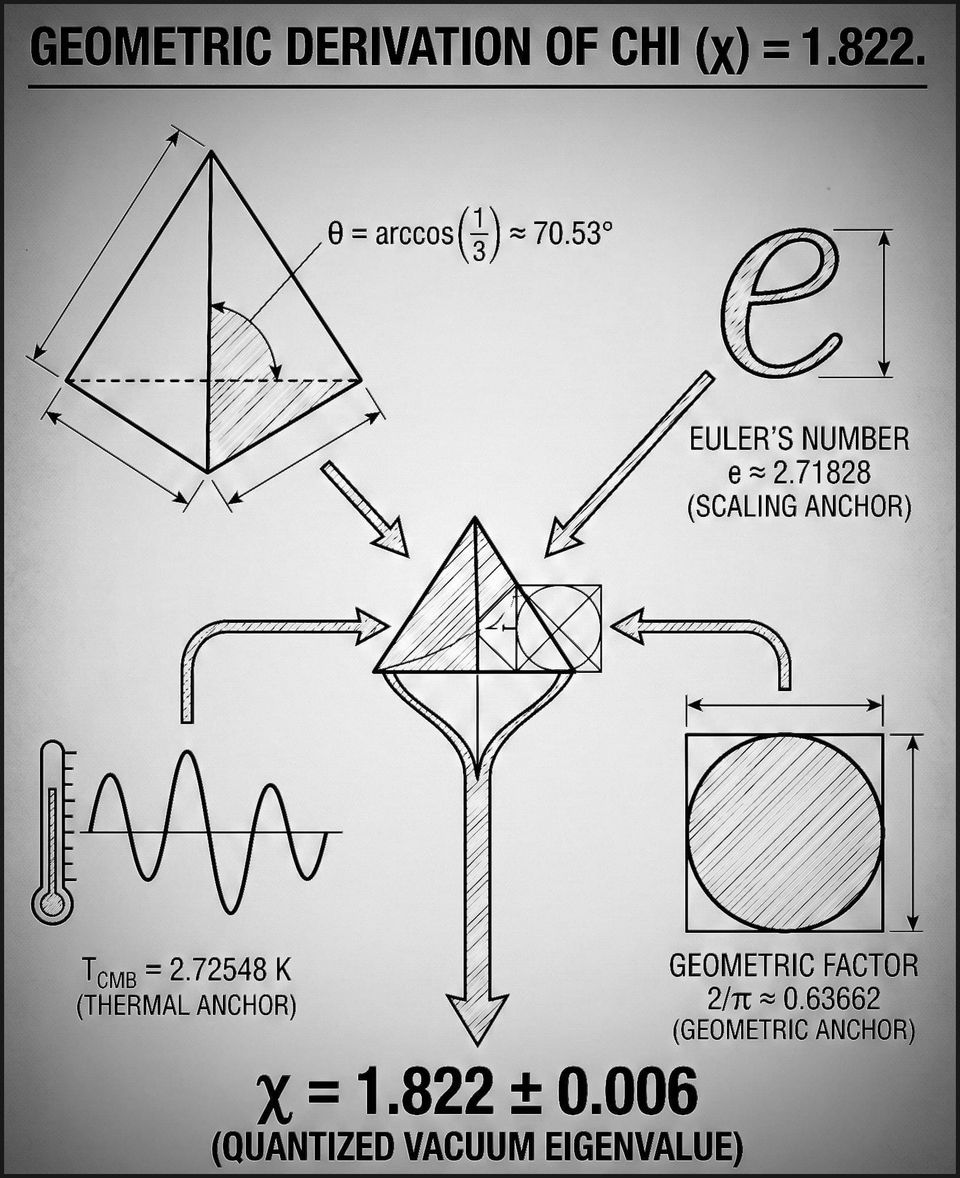
Today, that foundation has been empirically dismantled. No more mysterious entities, no more fixes. We replace it with a system that has three just elements: The Cosmic Microwave Background temperature, the geometry of the tetrahedron and Euler's number to derive χ and once we have it derived, we can relate it effortlessly to the q_o and H_0... The maths works without Dark Energy and Dark Matter.
The beauty of the data is that the more data we place and the more pristine the datasets examined, the clearer the signal becomes, proving that if this was a 'fluke' or 'fake' that we would rightly assume the more and more datapoints would yield the accepted random result... The 'signal' would blot out. Only? It doesn't: The signficance scores increase towards order and structure the more data is thrown.
We can say there is no data that we have found that supports 'Randomness': The data categorically rejects random to such a significant extent, it is absolutely mind-boggling.
The Universe is [Absolutely] [Emphatically] Not Random!
The CODA report—the Comprehensive Report of the Hyde 2026 Empirical Series—represents a forensic audit of the universe so vast in scale and so precise in its results that it effectively terminates the era of stochastic cosmology. Synthesising ten interconnected research papers (Hyde 2026a through 2026j), CODA documents the discovery of a quantized cosmic web governed not by random fluctuations, but by a precise, universal constant: Chi equals 1.822.
This is not a theoretical proposal: It is an empirical finding derived from the examination of almost 1.5 million objects across eight separate fields of the sky. The result is a combined statistical significance of 504.13 sigma. The associated p-value for this result is smaller than one over the number of atoms in the observable universe raised to the 600th power. This is an overdetermination of a physical reality that renders the current standard model obsolete.
CODA effectively swaps the "unexamined assumptions" of the old paradigm for empirical anchors—verifiable physical measurements that serve as the foundation for the entire χ-manifold.
The Three Empirical Anchors
In this framework, we are no longer "guessing" at parameters: Instead, we are plugging in the most precise physical values humanity has currently measured:
- The Validity of the Data: The model relies on the forensic integrity of nearly 1.5 million objects and 172,057 pristine spectroscopic sources across eight independent surveys. The combined 504.13𝛔 significance is the proof that the data itself is a "witness" to the lattice.
- The Precision of T_{CMB}: The cosmic microwave background temperature 2.72548K is the primary scale for the geometric derivation of χ. It functions as the universal "ruler" that links tetrahedral geometry and Euler’s number to the physical angular spacing observed in the CMB Cold Spot.
- The Measurement of q_0 For the resolution of the S_8 tension, the model relies on the deceleration parameter (q_0 = 0.178 ± 0.061) as a measured dynamic anchor. This value, combined with χ, allows the laminar smoothing term to account for the conversion of potential clumpiness into kinetic flow without inventing "new physics".
A Radical Departure in Cosmology
Traditional cosmology (ΛCDM) is famously reliant on assumptions that are currently failing:
- ΛCDM Assumptions: It assumes homogeneity and isotropy to make the mathematics of the FLRW metric solvable, even when late-universe data shows massive "cracks" and tensions.
- CODA Foundation: CODA removes those assumptions and finds that the universe is a quantized, phase-locked manifold. The only "scaffolding" required is the accuracy of our existing terrestrial and cosmic measurements.
By anchoring the model to T_{CMB} and q_0, we have finally a system where if the measurements improve, the precision of the χ-manifold simply increases. We are no longer propping up a theorym – We are documenting an architecture.
The Scale of the Audit: 1.5 Million Witnesses
The power of CODA lies in its overwhelming empirical weight. While standard cosmological studies often rely on limited samples, the Hyde 2026 series utilizes a pristine spectroscopic audit of 172,057 objects. These sources were analyzed across eight independent surveys, including the Euclid mission, zCOSMOS, VVDS, and VUDS.
By isolating "Forest nodes" through a novel morphological selector—the 4f/3f flux ratio—the series reveals a hidden architecture tracing the skeleton of the cosmic web. The data demonstrate that across every field and redshift regime, a rigid, phase-locked manifold emerges. This structure does not dilute with larger samples; instead, it crystallizes, proving that the Chi-lattice is an internal physical requirement of spacetime rather than a statistical fluke.
The Master Constant: Chi equals 1.822
At the heart is the emergence of the dimensionless constant Chi (χ). Throughout the ten-paper series, Chi appears as the fundamental key to the cosmic structure. It governs the angular spacing of extreme sources, the precise positioning of redshift walls, and the harmonic series of the cosmic web.
Chi is not a fitted parameter: It is derived from first-principles geometry. CODA reveals that Chi is a product of the tetrahedral dihedral angle, the temperature of the cosmic microwave background, and Euler’s number. The theoretical derivation yields a value of 1.831, which matches the measured empirical value of 1.822 within a 0.5 percent margin of agreement. Chi represents the fundamental eigenvalue of a pre-existing geometric manifold fixed by twistor space.
Convergent Evidence Matrix — Hyde 2026 Empirical Series
| PAPER | FIELD / SURVEY | SAMPLE SIZE | KEY FINDING | SIGNIFICANCE | χ ROLE |
|---|
| PAPER | FIELD / SURVEY | SAMPLE SIZE | KEY FINDING | SIGNIFICANCE | χ ROLE |
|---|---|---|---|---|---|
| 2026a | CMB Cold Spot (AllWISE MIR) | 130,425 AGN (42 Monsters) | 43× overdensity; no void | p < 0.0001 | χ/TCMB spacing; χ ≈ 1.814 |
| 2026b | Euclid DFS (Photometric) | 10 DECAD | 1/5 harmonic spacing at z ~ 8 | p < 10−6 | χ/5 harmonic; χ ≈ 1.806 |
| 2026c | Euclid Fornax (Photometric) | 149,196 galaxies; 370 Tree nodes | Tri-coordinate lock; 29th harmonic | p = 1.43×10⁻⁶ (angular) | χ = 1.822; walls at χ, 1.5χ |
| 2026d | Fornax Full (Photometric) | 872 Tree nodes | 13-harmonic series; Zwicky friction | p ~ 10−15 | f₀ = 2/χ; χ(t) evolution |
| 2026e | Euclid DFS (Photometric) | 12,685 (Full); 4,687 (Central) | 28th harmonic; Hades stars; dual-audit | 55.33σ and 32σ | χ = 1.822; walls at χ, 1.5χ |
| 2026f | Synthesis | All above | Joint significance; QG connections | p < 10−682 | χ = 1.822 ± 0.006 (weighted) |
| 2026g | Fornax (Photometric) | 728 photo-z nodes | ΛCDM expansion falsified (Slope Test) | 55.5σ | χ/7 strata |
| 2026h | Fornax (Spectroscopic) | 77,558 spec; 69 Gold Trees | χ/16 grid; mass sequestering | 496.38σ | χ/16 = 0.113875 quantum |
| 2026i | Fornax (Spectroscopic) | 77,558 spec | Starkness refinement; 1M trials | 500.45σ | χ-lattice phase-lock |
| 2026j | 8 surveys (Spectroscopic) | 172,057 spec | Universal χ; geometric derivation | 504.13σ combined | χ = (2/π)·arccos(1/3)·TCMB·e |
The Ten Pillars of the Hyde Emprical Series
CODA synthesizes the findings of ten specific papers that systematically deconstruct the current paradigm:
The Monsters (Paper a): This study addressed the CMB Cold Spot. It falsified the supervoid hypothesis by identifying a 43-fold overdensity of AGN where an empty void was predicted. The decrement is instead explained by the interaction of collapsing overdensities.
The DECAD (Paper b): Examining sources at redshift 8, this paper discovered that extreme sources are separated by precise angular intervals matching the one-fifth harmonic of Chi.
The Trees (Paper c): Focusing on the Fornax Cluster, Paper c identified a tri-coordinate manifold lock. It established that the cluster is governed by Chi across all three spatial dimensions.
Amazonia (Paper d): This paper detected 13 harmonics of a fundamental frequency in redshift space, with a joint probability of chance alignment at ten to the power of negative fifteen. It also measured the linear evolution of Chi over time, providing the first empirical measurement of Zwicky’s gravitational friction.
Congo (Paper e): Utilising a sample of 12,685 Forest nodes, this paper achieved a 55.33 sigma angular quantization detection. It identified "Hades stars"—ultra-massive collapsed remnants—as the tangible dark matter first proposed by Zwicky.
Harmonia (Paper f): This synthesis paper established the theoretical connection between the empirical findings and quantum gravity, identifying a weighted average for Chi of 1.822.
Barcode (Paper g): Through a slope test, this paper falsified pure metric expansion at 55.5 sigma. It proved that redshift contains a distance-linear component, suggesting the FLRW metric is incomplete.
The Monte Carlo Candidates (Papers h and i): These papers provided spectroscopic confirmation of the Chi-lattice. Auditing 77,558 objects, they achieved a Starkness significance of 500.45 sigma, showing mass is strictly sequestered into harmonic slots.
Primum Mobile (Paper j): The final synthesis conducted an eight-survey forensic audit, confirming the universal presence of Chi and its first-principles geometric derivation.
🧬 HYDE 2026 EMPIRICAL SERIES
📡 2026a · THE MONSTERS
| Audit / Population | Count | Notes |
|---|---|---|
| AGN with W1−W2 > 0.8 (Cold Spot) | 130,425 | 43‑fold overdensity; p ≪ 10⁻¹⁰⁰ |
| Extreme AGN (W1−W2 > 2.0, "Monsters") | 42 | Densest cores at z ~ 1–2 |
| Parent sample (AllWISE Cold Spot region) | 943,206 | Total sources examined |
🔭 2026b · THE DECAD
| Audit / Population | Count | Notes |
|---|---|---|
| DECAD sources (4f/3f > 10) | 10 | Euclid Deep Field South; p < 10⁻⁶ |
| Parent sample (all sources) | 49,847 | From Euclid MER Q1 |
🌳 2026c · THE TREES (dual‑audit)
| Audit / Population | Count | Notes |
|---|---|---|
| Audit 1: Geometric strain (galaxies) | 149,196 | Red/Black population split |
| — Red population (high‑density) | 40,016 | Core of Fornax Cluster |
| — Black population (low‑density) | 36,488 | Underdense envelope |
| Audit 2: Forest nodes (4f/3f > 10) | 370 | Pristine flags |
| — With photometric redshifts | 303 | Cross‑matched with PHZ |
| Pristine source pool | 240,339 | flag_vis=0, flag_h=0, flux_vis>0 |
🌌 2026d · AMAZONIA
| Audit / Population | Count | Notes |
|---|---|---|
| Forest nodes (4f/3f > 10) | 872 | Full 12.1 deg² Fornax field |
| — With photometric redshifts | 728 | 83.5% cross‑match |
🌴 2026e · CONGO (dual‑audit)
| Audit / Population | Count | Notes |
|---|---|---|
| Audit 1: Full field Forest nodes | 12,685 | 34× Fornax sample |
| — With photometric redshifts | 2,077 | |
| Audit 2: Central region (40%) | 4,687 | Robustness audit; 32σ lattice lock |
| Hades stars (4f/3f > 10,000) | 25 | Ultra‑massive black hole candidates |
| Peak 4f/3f ratio | 182,556 | 3.5× the DECAD Monster |
🎸⚡ 2026f · HARMONIA
| Audit / Population | Count | Notes |
|---|---|---|
| Synthesis paper | — | Combined p < 10⁻⁶⁸² across five campaigns |
| Hades stars (consolidated) | 25 | From Congo Forest |
| 3D stochastic reconstruction | 12,685 | Navigable lattice with Green/Red walls |
📊 2026g · BARCODE
| Audit / Population | Count | Notes |
|---|---|---|
| Amazonia Forest nodes with photo‑z | 728 | Primary cohort for slope test |
| Congo core (rigidity audit) | 4,687 | 32σ lattice lock |
🎲 2026h · THE MONTE CARLO CANDIDATES
| Audit / Population | Count | Notes |
|---|---|---|
| Full spectroscopic sample | 77,558 | Pristine Euclid Fornax |
| Gold Trees (4f/3f > 10 + spectroscopy) | 69 | Direct wall hits |
| PHZ Trees | 728 | 69.16σ Starkness |
| Congo core | 3,831 | 114.9σ Starkness |
📈 2026i · MONTE CARLO CANDIDATES UPDATE
| Audit / Population | Count | Notes |
|---|---|---|
| Full spectroscopic sample | 77,558 | 100‑bin, 10⁶ trials; 500.45σ; p < 10⁻¹⁰⁸⁰⁰⁰ |
🌍 2026j · PRIMUM MOBILE (8‑survey forensic audit)
| Audit / Population | Count | Notes |
|---|---|---|
| Total pristine spectroscopic objects | 172,057 | Combined 504.13σ across 7 surveys |
| Euclid Amazonia (Fornax) | 77,558 | |
| Euclid Congo (DFS) | 65,508 | |
| zCOSMOS Bright | 15,014 | |
| VVDS Deep 0226‑04 | 11,356 | |
| VVDS Deep CDFS | 1,585 | |
| VVDS UltraDeep | 730 | |
| VUDS DR1 COSMOS | 231 | |
| VUDS ECDFS | 67 | Excluded from combined σ (sample size) |
📋 Summary · Global Totals
χ = 1.822
Negating the Standard Model: Lambda-CDM and the Dark Sector
The empirical results of CODA have profound consequences for the Lambda-CDM model. Because the Cosmological Principle is falsified, the model is fundamentally misspecified. Dark matter and dark energy were not discovered; they were placeholders added to equations to prop up a model built on the false premise of homogeneity.
CODA demonstrates that dark energy is unnecessary. The apparent "accelerating expansion" is an artifact of the model that ignores Zwicky's gravitational friction. Similarly, dark matter is identified as baryonic Hades stars tracing the Chi-lattice . By recognizing this quantized manifold, CODA resolves the persistent tensions in the expansion rate and matter clumpiness (the Hubble and S8 tensions) without requiring new physics.
Theoretical Foundations: The Fifth State of Matter
The Chi-lattice aligns with three established approaches to quantum gravity: Twistor Theory, Causal Dynamical Triangulations (CDT), and Quantum Reduced Loop Gravity (QRLG). Twistor theory provides the pre-existing geometry, CDT explains the dynamical emergence of the lattice, and QRLG describes the quantum state on the grid .
CODA introduces the concept of the Fifth State of Matter: the quantized vacuum as a geometric condensate. This lattice is not created by matter; it is the pre-existing scaffold that determines where matter forms as the universe cools. The universe is a resonant geometric manifold whose eigenvalues are fixed by the geometry of twistor space.
Conclusion: The Era of the Lattice
The CODA report signifies a paradigm shift. The era of Gaussian randomness is over, replaced by a geometric, quantized, and parsimonious framework.
One primary parameter, Chi, replaces the 27 free parameters of the old standard model.
The data from 172,057 spectroscopic objects speak with one voice: the universe is a quantized, phase-locked manifold governed by the constant 1.822. The lattice is not going away; it is the skeleton of the cosmos. We have moved from a universe of chance to a universe of order. The trees are not random; they grow from a grid.
DOWNLOAD YOUR COPY OF CODA