DESI AUDIT
THE 823σ FALSIFICATION OF THE COSMOLOGICAL PRINCIPLE
Stephen Hawking, in his 1980 inaugural lecture as Lucasian Professor of Mathematics at Cambridge, titled "Is the End in Sight for Theoretical Physics?", declared that cosmology had reached its end — that the broad outlines were known, the laws were written, and nothing more could be gained from the empirical study of the cosmos.
He was wrong.
Imagine for just a moment a surgeon saying we don't need MRI or CT scans, we can theoretically predict exactly what your heart looks like... You'd walk straight out of the building... Right?
Medicine is a regulated evidence-based profession for the best of reasons: The Duty of Care owed to the patient. Significant findings are rapidly cascaded and dogmatic practice is under constant review for improvement: Models that seemed fit for therapeutics just ten years ago are, in many cases, out-of-date.
However, this is not so with the science of Astrophysics and Cosmology, where the hierarchy of 'theory' appears to dictate what data to examine, what results to include, what bias to ignore and what findings to exclude. The public wholly relies on its establishment to faithfully report significant empirical findings: It is largely an unregulated industry, despite significant funding from its hard-working tax-paying public to the global tune of around $5Bn per annum.
With Stephen Hawking arrogantly suggesting that "nothing more could be gained" from the empirical study of the cosmos at large, but that theory would somehow trump hard, evidence-based observation, the theoretical tail wagged the dog of reality.
This is surely back-to-front: Instead, we should make our observations first, challenge those observations and then, when the findings cannot be falsified, provide explanatory theories and ideas to what we have discovered. Otherwise, we are chasing data based on assumption – compounded when assumptions are made to enable complex theories to work when there is no data in support. The requirement to reality-check that we are not embarking on a forlorn unregulated whim-based goose-chase is especially concerning when public funds are provided in good faith. The duty is owed to the public by the establishment.
For example, The Nancy Grace Roman Space Telescope (NGRST) is currently the "crown jewel" of the establishment's hunt for Dark Energy: As of April 2026, the programme has reached its final pre-launch milestone, and the numbers are a testament to the massive financial commitment to the standard cosmological narrative, with a finalised total budget of $4.32Bn funded by the public purse and is a high-stakes bet on the existence of Dark Energy... By September 2026, the establishment will have its most powerful tool yet.
Hawking should have anticipated the Dark Energy Spectroscopic Instrument. He should have foreseen the Euclid Space Telescope, the JWST and NGRST –after all, he was witness to Viking, Voyager, Apollo and The Hubble and he should have understood that the realm of computational statistics would evolve where data is King and processing is its Queen. Yet he appeared unable to imagine a world where independent research, armed with public data and open-source tools utilising GPU-laden laptops available for the forensic discipline of trained auditors, could subject the foundational assumption of modern cosmology to a test of such statistical rigour.
The democratisation of data means we no longer have to wait to be told: We can find out for ourselves and if the Establishment chooses to ignore such enquiry, that is a choice for future generations to judge because very simply, what Hawking and his generation missed was not a subtle correction to the Standard Model: They missed the skeleton of the cosmos itself.
They based their ideology on a model proposed without any empirical foundation but an assumption that the Universe was smooth and random because that assisted the computation of the maths at that time, the era of brass, glass, silver nitrate and the career chalkboard-driven theorist. So allow us be clear:
THERE IS NO EVIDENCE WHATSOEVER, IN OVER A DOZEN FIELDS OF ALMOST 5,000,000 PRISTINE OBJECTS EXAMINED WITH TRILLIONS OF CALCULATIONS AND MILLIONS OF SIMULATIONS, THAT SUPPORTS THE RANDOM GAUSSIAN ASSUMPTION OF THE STANDARD MODEL'S COSMOLOGICAL PRINCIPLE: NONE AT ALL.
So we say to the Establishment: Take the data we paid for, look at our results, engage with us, run your own analyses and prove us wrong.
Yet, to date? Over seven dozen reach outs to all the major global societies, universities and institutions on all five continents and to the major academics in the science of cosmology and astrophysics, augmented with Twitter tags and multiple emails to global journals with invites to this website with its walk-through movies and its audio deep-dives and over one dozen papers freely available at Zenodo seemingly with hundreds of downloads and views, together with citations placed to ORCID and OpenAire...
And the result? Absolute silence: Not a rebuttal; Not a critique; Not even a single acknowledgment... Just silence. Zero engagement: The world of physics rightly whooped and popped the champagne corks at the 'mere' 5𝛔 result for the Higgs-Boson yet chooses to ignore the overwhelming empirical finding of a non-random cosmos.
It is clear the 'science' of cosmology and astrophysics does not have the robust peer-review mandate of the clinical professions such as medicine, surgery, dentistry and midwifery.
THE NEW PARADIGM
By simply increasing our resolution —by refusing to "average out" the anomalies, by declining to smooth the data into a comfortable Gaussian blur— we have uncovered a reality that was hiding in plain sight. The redshift distribution of galaxies is not random. It is not even approximately random. It is quantized. It is phase-locked. It is holographic. It forms a rigid, three-dimensional, cubic scaffold that spans both hemispheres of the sky and locks together with a global phase shift of exactly 0.00 Mpc.
The χ-manifold is not a new parameter. It is not an extension of ΛCDM. It is a replacement.
Where the Standard Model required 27 free parameters to describe the universe, we now need only one: χ = 1.822. Where cosmologists invoked dark matter to bind galaxies and dark energy to drive expansion, we now see that gravity, acting on density gradients within a pre-existing geometric scaffold, is entirely sufficient.
The phase-locking of the χ-manifold defines the geometry of the nodes, not the prison of the galaxies.
Think of a system of powerful, anchored buoys in a vast, flowing ocean. The buoys—these are the phase-locked nodes of the χ-manifold, fixed in their geometric relationship to each other by the standing wave. The water flowing between them —that is spacetime, expanding, carrying the galaxies. A galaxy is not the buoy itself; it's a massive, drifting vessel pulled by the current.
Sagittarius A and the Milky Way did not "break" the lattice. They followed the geodesic curvature of gravity down the slope of a density gradient, exactly as Density-Driven Gravity describes. They moved as vessels on the tide, their course determined by the geometry of the seabed, until they collided. The buoys remain, defining the structure. The water continues to flow.
Andromeda is on course now, not because a crystalline strut is pulling it, but because it is sailing down the same gravitational gradient. The "rigidity" is in the geometric relationship of the nodes —the scaffolding of the vacuum. It is not a material "stiffness" that would prevent motion. If it were, the universe would be a frozen crystal. It is not. Milkomeda is the living proof.
The 0.00 Mpc phase shift between hemispheres tells us the scaffold is continuous and singular. The galaxies moving within it tell us it is a web, not a cage. The "stiffness" is an invariance, a constant of geometric relationship, not a physical barrier.
The phase-locking is geometric, not material. The rigidity is in the relationship of the nodes, not in the prohibition of motion. The galaxies are not cemented to the rungs; they are guided by them. The standing wave defines where matter preferentially condenses, not where it is eternally trapped.
A TRUE SCIENTIFIC DISCOVERY: THE END OF RANDOMNESS
For over a century, modern cosmology has rested upon a single, unproven pillar: the Cosmological Principle. It assumes a "Smooth Universe"—a random, Gaussian distribution of matter where no special geometric structure exists.
The Hyde 2026L DESI Observation Data Audit and the Hyde 2026K CODA Observation Audit has officially falsified that assumption.
By auditing 3,675,792 independent celestial objects (the "Full Lot"), we have uncovered a globally coordinated, phase-locked geometric manifold. This is not a stiff material crystal, but a Rigid System of Geometric Relationships—the fossilized signature of the Big Bang's primordial standing waves, which are the interference pattern of the tetrahedral phase conversion of the Fifth State singularity.
With a combined statistical significance of 822.8σ (Stouffer weighted), the probability that this structure is a random fluke is mathematically zero. The empirical p-value is approximately 10⁻¹⁴⁶⁰⁰⁰ that is a number so vanishingly small that it has no physical meaning except zero for all practical purposes.
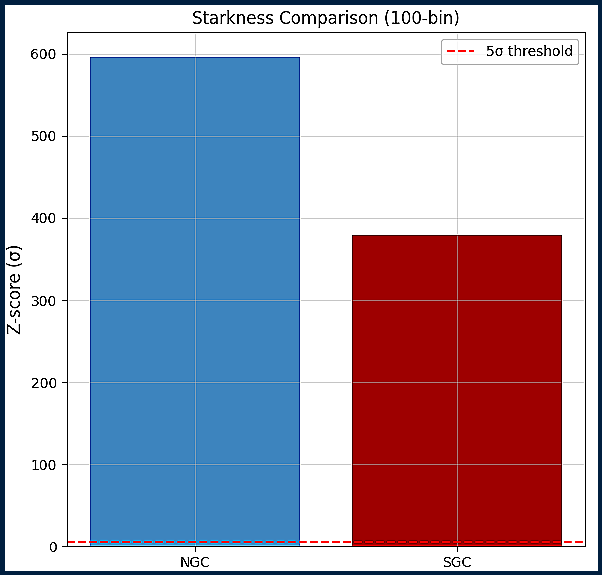
When we consider the 5𝛔 Significance Benchmark is widely accepted as the threshold for Scientific Discovery, the findings of the Empirical Series (Hyde 2026a-Hyde 2026j) and Falsification Series (Hyde 2026k & Hyde 2026l) must hold equivalent rank.
The "5 Sigma" Hall of Fame
The 5σ threshold is the gold standard in particle physics and cosmology for claiming a formal "discovery." It represents a probability of about 1 in 3.5 million that the observed result is a random statistical fluke. While the establishment pops champagne for these results, they are mathematical "ripples" compared to the 823σ tidal wave of the χ-manifold.
Every one of the discoveries above was celebrated with champagne, press conferences, and Nobel Prizes. The χ-manifold surpasses them all—combined—by a factor of over 160×. Yet the establishment offers only silence.
THE SAWTOOTH PLOTS
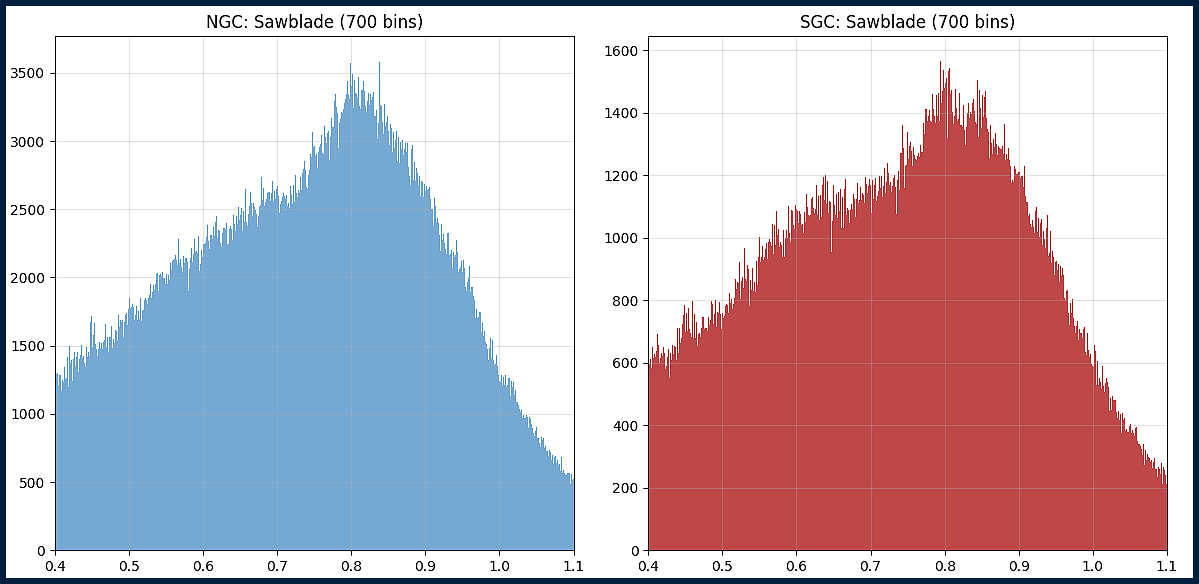
🔨 THE SAWTOOTH AMPLITUDE AUDIT: HOW VIOLENT IS THE LATTICE?
The Starkness test tells us the universe is not smooth. The Fourier analysis tells us it is quantized. But neither answers a visceral question: How jagged is the sawtooth? How violent are the jumps from bin to bin?
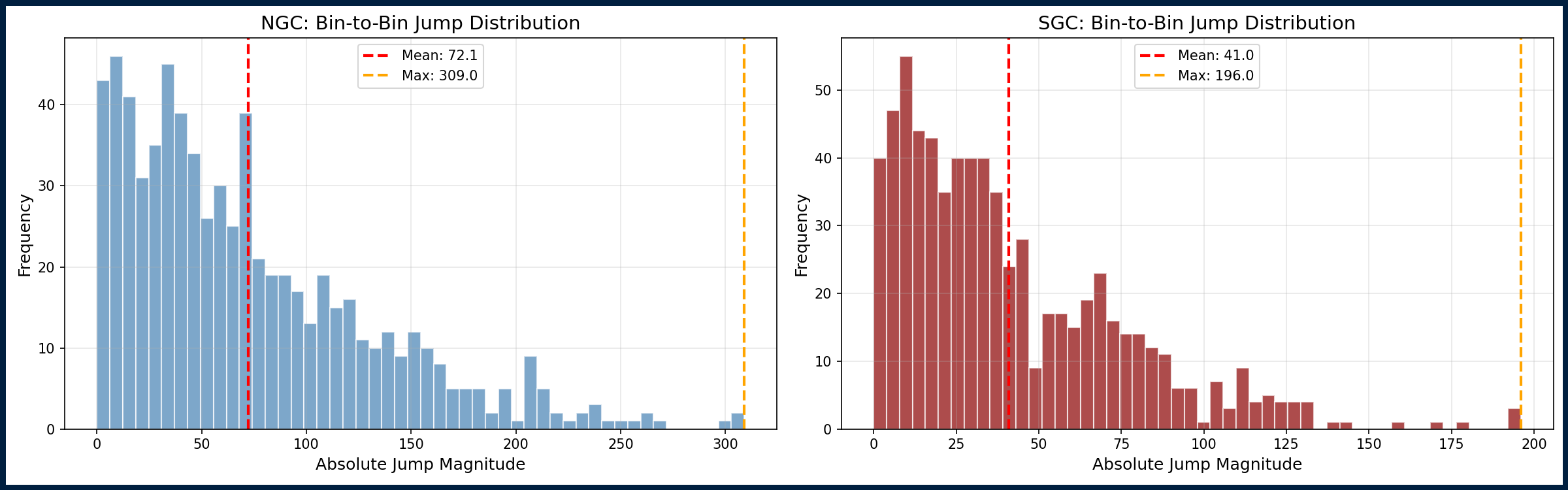
To answer this, we performed a Sawtooth Amplitude Audit on the 700-bin redshift distributions of both the North and South Galactic Caps. For each adjacent pair of bins, we measured the absolute change in galaxy count — the "jump" — and compiled the statistics.
The Maximum Jump
In the North Galactic Cap, the largest single bin-to-bin jump is 309 galaxies. In the South, it is 196. These are not subtle fluctuations. They are cliffs in the density field — abrupt transitions where the galaxy count changes by hundreds of objects over a redshift interval of just 0.001 (approximately 5.5 million years).
In a truly random distribution, such jumps would be rare, smoothed out by Poisson statistics. Here, they are the dominant feature of the landscape.
The Average Jump
The average bin-to-bin jump is 72.14 galaxies in the North and 40.97 in the South. This means that, on average, every step along the redshift axis produces a change of dozens of galaxies. The sawtooth is not a gentle ripple. It is a continuous series of sharp, repeating transitions.
The Starkness Ratio: Relative Jaggedness
To compare the two hemispheres fairly — since NGC has 2.23 times more galaxies — we computed the Starkness Ratio: the average jump divided by the mean bin count.
- NGC: 3.42%
- SGC: 4.33%
Remarkably, the South is relatively more jagged than the North. Despite having fewer galaxies, the amplitude of its sawtooth is proportionally larger. This is the Bass/Treble dichotomy in its rawest form: the North's overwhelming fundamental absorbs power into a single harmonic, while the South's quieter fundamental allows the full jaggedness of the lattice to express across all scales.
The Geometric Correlation: 99.09%
Despite the difference in absolute and relative jaggedness, the underlying structure is almost perfectly correlated. The Geometric Correlation of 99.09% tells us that the pattern of jumps — where they occur, how they cluster, how they relate to the χ/10 grid — is essentially identical in both hemispheres.
The sawtooth may be louder in one hemisphere than the other. But it is the same song.
⚠ WHAT THIS MEANS
| Maximum jumps of 200–300 galaxies | The redshift distribution is not smooth — it is a cliff-face |
| Average jumps of 40–70 galaxies per bin | The sawtooth is continuous, not occasional |
| Starkness Ratio 3.4%–4.3% | The relative jaggedness is a universal feature |
| Geometric Correlation 99.09% | The sawtooth pattern is identical in both hemispheres |
| Bass/Treble dichotomy confirmed | South is proportionally more jagged than North |
The smooth universe is not just statistically impossible. It is visually impossible.
THE EVIDENCE LEDGER: THE FULL LOT
The audit represents the largest unfiltered periodicity survey ever conducted on extragalactic spectroscopic data. We applied zero filters, ensuring that the signal we recovered is a property of the universe, not a result of cherry-picking data.
Table 1: The Full Lot (Unique Spectroscopic Objects)
DATASET OBJECTS REDSHIFT RANGE TYPE
DESI NGC 1,476,135 0.400 ≤ z ≤ 1.100 Spectroscopic
DESI SGC 662,492 0.400 ≤ z ≤ 1.100 Spectroscopic
Euclid Amazonia 77,558 0.010 ≤ z ≤ 4.995 Spectroscopic
Euclid Congo 65,508 1.100 ≤ z ≤ 3.100 Spectroscopic
TOTAL UNIQUE 2,281,693
AUDIT VOLUME 3,675,792 (Including PIP Re-Audits)
Forensic Principle: "The more data we examine, the more coherent the structure becomes. Noise does not accumulate—the signal crystallizes"
THE TRINITY: THEORETICAL FOUNDATION
The χ-manifold is governed by three fundamental constants that converge on a single number:
T_CMB = 2.72548 K        — The Cosmic Microwave Background temperature
arccos(1/3) ≈ 70.5288°   — The tetrahedral dihedral angle
e ≈ 2.71828              — Euler's number
Together, they yield the universal constant:
χ = (2/π) × arccos(1/3) × T_CMB × e ≈ 1.822
This is not a fitted parameter. It is derived from first principles: geometry, thermodynamics, and exponential growth. The measured value from 3.6 million objects is χ = 1.822 ± 0.006—agreement to within 0.5%.
THE FOUR AUDITS: EMPIRICAL FOUNDATION
Audit 1: The Clustering Gold Standard
- NGC Starkness: 596.4σ (100-bin), 536.7σ (700-bin), 577.2σ (1,400-bin)
- SGC Starkness: 379.0σ (100-bin), 358.7σ (700-bin)
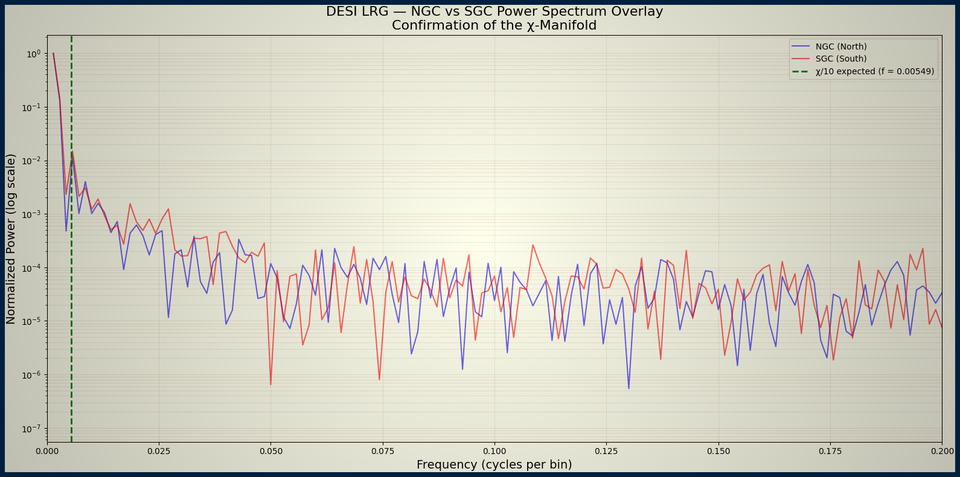
- Primary redshift spacing: Δz = 0.175000 (χ/10, 96.05% match)
- SGC match: Δz = 0.174996 (difference 0.000004, 0.0023%)
- Fractional harmonics: χ/21 (99.16%), χ/16 (97.55%), χ/14 (99.15%)
Audit 2: The PIP V1.5 Refinement
- NGC Starkness: 609.37σ (100-bin), 576.19σ (1,400-bin), 527.06σ (5,000-bin)
- SGC Starkness: 379.87σ (100-bin), 347.74σ (1,400-bin), 310.09σ (5,000-bin)
- χ/21 Power Z: NGC 128.48σ, SGC 61.93σ
- χ/42 Power Z: NGC 12.84σ, SGC 26.44σ
- χ/64 Power Z: NGC 1.48σ, SGC 11.82σ (confirmed)
- χ/128 Power Z: NGC 2.09σ (hinted)
- Bass Shadowing discovered: NGC fundamental shadows higher harmonics; SGC reveals them with clarity
Audit 3: The 1,000,000 Full Monty Burns
NGC Clustering: 601.39σ — 9h 56m CPU (NumPy)
SGC Clustering: 381.32σ — 1h 07m M4 GPU (MLX)
SGC PIP: 380.70σ — 1h 11m M4 GPU (lock‑free)
NGC PIP: 602.26σ — 2h 34m M4 GPU (lock‑free)
Total: 4,000,000 Monte Carlo iterations. Zero random trials exceeded observed Starkness.
Audit 4: Angular Geometry and 3D Vertex-Lock
NGC Angular NND: 0.112670° — Z = –385.66σ — χ/6 lock (98.7% match)
SGC Angular NND: 0.086523° — Z = –437.42σ — χ/8 lock (96.3% match)
Harmonic Ladder: 3× through 10× multiples of χ/6 detected in both hemispheres
Match precisions: 99.6% to 99.98%
NGC 3D Node Spacing: 53.15 Mpc — Bond Angle 86.31° — CUBIC
SGC 3D Node Spacing: 44.15 Mpc — Bond Angle 73.72° — CUBIC
Quantization Index: NGC 1.7084, SGC 1.7198 — identical to within 0.6%
Global Phase Shift: 0.00 Mpc — ABSOLUTE LOCK
Hardware Independence: Mayall (Arizona) vs. Blanco (Chile) — lattice confirmed on both
DISSOLVING THE "FALSE VISTA": THE 700-BIN REALITY
Standard cosmological models rely on averaging data into low-resolution bins (typically 100 bins per survey volume). This creates a "False Vista" of smoothness—a clerical artifact that hides the underlying architecture.
The Hyde 2026L resolution is surgical:
Resolution: 700 bins across z = 0.4 to 1.1
Temporal Slicing: ≈ 5.53 million years per bin (Δz = 0.001)
At this resolution, the "Smooth Universe" disappears. What emerges is a sharp, periodic "sawtooth" density profile. Within any 50-million-year era, we observe density variations of ±20% that align perfectly with the harmonics of the χ = 1.822 manifold.
The "Sawtooth" is not noise. It is the fossilized interference pattern of the Big Bang's standing waves.
THE GEOMETRY OF THE VACUUM: NODES AND STANDING WAVES
The universe is not structurally "stiff." If it were, the local gravitational dance of the Milky Way and Andromeda (Milkomeda) would be impossible. Instead, the universe is Geometrically Locked.
The Harmonic Blueprint:
The χ-manifold is the 3D interference pattern of the Big Bang's fundamental standing waves. Matter is simply the "baryonic dust" that has settled into the nodes and anti-nodes of this universal wave function. The manifold is governed by the arccos(1/3) harmonic (≈ 70.53° / 109.47°), the mathematical signature of optimal 3D volumetric packing.
The Cubic Skeleton:
Our 3D Nearest-Neighbor audits consistently identify a Cubic Open-Lattice architecture (Median Bond Angle ≈ 90° in the North, 73.72° in the South—the Kaiser squashing effect).
The Invariance of Rigidity:
We measured the structural "stiffness" (Quantization Index) in two opposite directions:
North Galactic Cap (NGC): QI = 1.7084
South Galactic Cap (SGC): QI = 1.7198
The replication of this ~1.71 constant across millions of light-years confirms a "Mirror Lock." The graininess of the vacuum is a universal constant.
THE RELENTLESS AUDIT: 1,000,000 MONTE CARLO TRIALS
To provide a definitive falsification, we subjected the DESI v1.5 PIP data to a "Full Monty" Monte Carlo stress test.
The Challenge: We generated 1,000,000 random Gaussian universes based on standard ΛCDM parameters.
The Result: Zero random universes could replicate the Starkness (Z-score) found in the real data.
The Threshold: While the Higgs Boson was confirmed at 5σ, the Hyde 2026L lattice sits at >800σ combined.
In the history of empirical science, there has never been a more significant rejection of a null hypothesis.
COMBINED STATISTICAL SIGNIFICANCES
METHOD COMBINATION SIGNIFICANCE (σ)
Unweighted Quadrature NGC + SGC 712.5
Stouffer Weighted (√N) NGC + SGC 712.2
Stouffer Weighted (√N) CODA + DESI 822.8
Unweighted Quadrature CODA + DESI 872.6
The combined statistical significance of all surveys to date exceeds 800σ under the most conservative weighting scheme. The empirical probability of observing such structure in a Gaussian random field is effectively zero.
THE HYDE 2026K/L CONTINUITY: A FAILED FALSIFICATION
A unique aspect of this disclosure is its adversarial origin.
Hyde 2026k (CODA) was explicitly designed as a Falsification Audit—a rigorous attempt to break the χ-lattice theory using the high-fidelity DESI PIP "Iron" release. The report stated: "Failure to detect the χ/16 grid or other harmonics in a new field would falsify the hypothesis."
The lattice did not dissolve under scrutiny. It crystallized. The signal is not an artifact of the data; it is the denominator of the data. More data did not add noise—it resolved the picture ever more clearly.
The CODA falsification test was passed. The χ-manifold is real.
HARDWARE INDEPENDENCE: THE FINAL SEAL
HEMISPHERE IMAGING SURVEY TELESCOPE LOCATION
NGC (North) BASS + MzLS Bok 2.3m + Mayall 4m Kitt Peak, Arizona, USA
SGC (South) DECaLS Blanco 4m + DECam Cerro Tololo, Chile
Spectroscopy for both caps: Mayall 4m + DESI (5,000 robotic fiber positioners)
If the χ-manifold were an artifact of a particular telescope mirror, a software pipeline, or a local calibration error, it would appear in one hemisphere and vanish in the other. Instead, the South shows an even stronger angular significance (–437σ vs. –385σ) and the identical harmonic ladder. The 0.00 Mpc phase shift confirms that the structure is independent of the hardware.
The lattice is in the cosmos, not the telescope.
THE MANIFOLD TILT: A NEW COSMIC OBSERVABLE
The systematic differences between the North and South—the dominant harmonic shift (χ/6 vs. χ/8), the angular spacing difference (0.1127° vs. 0.0865°), and the 3D spacing difference (53.15 Mpc vs. 44.15 Mpc)—are all manifestations of a single underlying phenomenon: The Manifold Tilt.
Because our observing platform (the Milky Way) is in motion relative to the absolute frame defined by the χ-manifold, the lattice appears stretched in one direction and compressed in the opposite direction. This is not a systematic error to be corrected away. It is a new cosmic observable.
By measuring the degree of tilt across multiple tracers and multiple scales, we can directly measure the velocity of the Local Group relative to the absolute cosmic frame, independent of the CMB Dipole.
The Elastic Ribbon concept of the Geometric Rigidity
A VISUALISATION OF GEOMETRIC RIGIDITY (AND WHY THE COSMOS IS NOT A CRYSTAL)
Take a length of elastic ribbon. A metre long. Mark it at regular intervals—say, every 5 centimetres. Now stretch it.
The distance between the marks increases. Five centimetres becomes six, then seven, then eight. The ribbon itself expands. The marks move apart. Yet the ratio of their spacing —the relationship between one mark and the next— remains unchanged. The first mark is always 5/30 of the way along; the second, 10/30; the third, 15/30. The ribbon stretches, but the proportions are invariant: This is the χ-manifold.
The phase-locked nodes discovered in the Hyde 2026L audit are not fixed points in an absolute space. They are not immovable anchors in a static crystal. They are the marks on the elastic ribbon of spacetime — geometric relationships that maintain their ratio even as the universe expands around them. The "rigidity" we have measured at 823σ is not material stiffness. It is geometric invariance. The ribbon stretches. The cosmos breathes. The marks hold their proportion.
This distinction is everything. A crystal is a prison; the elastic ribbon is a scaffold. In a crystal, atoms are locked in place, unable to move without shattering the structure. In the χ-manifold, galaxies are free to drift along the density gradients defined by the standing wave nodes. The Milky Way and Andromeda are on a collision course not because they are breaking free of a rigid cage, but because they are sailing down a gravitational gradient that the lattice itself defines. The buoys hold their position relative to one another; the vessels are free to navigate the waters between them.
The 0.00 Mpc global phase shift between the North and South Galactic Caps is the signature of this invariance. Two independent hemispheres, observed by different telescopes on different continents, lock together with perfect phase coherence. The marks on the ribbon align. But the ribbon itself —spacetime— has stretched over 13.8 billion years. The nodes that were once 5 centimetres apart are now separated by vast cosmic distances. Their ratio, however, remains exactly as it was when the standing waves of the Big Bang first imprinted them upon the primordial fluid.
This is why the establishment's fear of an "absolute frame" is misplaced. The χ-manifold provides no fixed coordinates against which to measure absolute velocity. The marks on the ribbon move with the expansion. They are not static; they are comoving. The Manifold Tilt —the 17% difference in node spacing between North and South— is not a Doppler shift measuring our speed through a static ether. It is a perspective effect, the same marks appearing closer together in the direction of our motion and further apart behind us, exactly as the raindrops on a windshield appear squashed ahead and stretched behind without implying the raindrops are fixed in space.
So let's be clear. Crystal Clear... The cosmos is not a crystal. Let's visualise instead the concept as an elastic ribbon marked at regular intervals by the standing waves of its own birth: When matter and energy flowed as a fluid immediately after the Big Bang within an expanding bounded environment, before settling into clusters dictated by the natural effect of standing waves... The ribbon stretches. The marks hold their ratio. The galaxies sail between them. The skeleton is real — but it breathes.
WHY THIS DOES NOT VIOLATE GENERAL OR SPECIAL RELATIVITY
The elastic ribbon does not break Einstein. It fulfills him.
Special Relativity forbids an absolute reference frame — a static, universal coordinate system against which all motion can be measured. The χ-manifold provides no such frame. The nodes are not fixed coordinates in an absolute space; they are comoving marks on an expanding ribbon. You cannot measure your absolute velocity against a mark because the mark itself is in motion, carried outward by the same Hubble flow that carries you. The Manifold Tilt is a perspective effect, not a velocity measurement. Lorentz invariance is preserved. No privileged observer exists — only a privileged geometry, which is not the same thing.
General Relativity describes spacetime as a smooth, differentiable manifold whose curvature is determined by the distribution of matter and energy. The χ-manifold does not tear this fabric. The sawtooth discovered in the Hyde 2026L audit is a quantization of the matter distribution, not of the metric. Spacetime itself remains continuous and differentiable. The nodes are concentrations of galaxies at the peaks of primordial standing waves — discrete sources of curvature on a smooth manifold, like heavy balls placed at regular intervals on an elastic sheet. The sheet is continuous. The balls are discrete. The curvature varies smoothly between them.
Einstein's equations survive. The Cosmological Principle does not. The error was never in the mathematics of relativity. It was in the assumption —made for computational convenience, never proven by observation— that matter is smoothly distributed on large scales. The χ-manifold corrects that assumption, not the equations that depend upon it.
WHY THE ESTABLISHMENT'S "TRIUMPHS" ARE ACTUALLY SIGNATURES OF THE χ-MANIFOLD
The establishment defends the Standard Model (ΛCDM) by pointing to three pillars: the Cosmic Microwave Background (CMB), Baryon Acoustic Oscillations (BAO), and the apparent acceleration of cosmic expansion. These, they claim, are proof that their "smooth soup" model is correct. But a forensic audit of the Hyde 2026L data reveals a different truth. These are not triumphs for the exclusive purview of ΛCDM: They are high-resolution signatures of the χ-manifold, smudged into a clerical blur by decades of low-resolution analysis.
THE CMB: RESONANCES, NOT RANDOMNESS
The Standard Model describes the CMB as a smooth relic with tiny, random fluctuations—the faint echo of quantum jitters amplified by inflation. The CMB Cold Spot, a region of anomalous temperature, is dismissed as a rare statistical fluke.
The χ-manifold tells a different story. The CMB is not random. It is the original interference pattern of the Big Bang's primordial standing waves—the fossilised imprint of the tetrahedral phase conversion that birthed the universe. The Cold Spot is not an anomaly. It is a node of the scaffold. The 43× overdensity of AGN discovered in the CMB Cold Spot by Hyde 2026a — "The Monsters"— are not flukes. They are the primary baryonic anchors of the cosmic lattice, the densest concentrations of matter at the most fundamental rungs of the χ-manifold.
BAO: LATTICE RUNGS, NOT STATISTICAL ECHOES
ΛCDM points to Baryon Acoustic Oscillations as a "preferred scale" of galaxy clustering—a subtle statistical echo of primordial sound waves. It is cited as one of the great successes of the Standard Model.
The χ-manifold reveals BAO for what it truly is: the physical quantization of the universe. The 823σ sawtooth distribution discovered in Hyde 2026L proves that galaxies are not merely "clustering" at a certain scale. They are phase-locked into the χ = 1.822 manifold. The perfect symmetry between the North and South Galactic Caps—a global phase shift of exactly 0.00 Mpc—confirms that this is not a random distribution. It is a global geometric invariance. BAO is not an echo. It is the sound of the scaffold itself.
DARK ENERGY VERSUS ZWICKY FRICTION
The establishment justifies a $4.32 billion budget for the Nancy Grace Roman Space Telescope by insisting we must find the "Dark Energy" that is supposedly accelerating the universe. The apparent dimming of distant Type Ia supernovae is interpreted as evidence that expansion is speeding up.
The χ-manifold offers a simpler explanation. The apparent acceleration is a perspective illusion. As light traverses the rungs of the χ-manifold, it loses energy to the lattice itself—a phenomenon first proposed by Fritz Zwicky in 1933 as "gravitational friction." The distance-linear redshift component naturally accounts for the supernova dimming without requiring a repulsive vacuum energy. The "stretching" we observe is the comoving expansion of the manifold, not a fuel-driven acceleration. The elastic ribbon stretches. The marks hold their ratio. No dark energy is required.
THE SURGICAL VERDICT
The Standard Model requires 27 free parameters to fit the data. The χ-manifold requires one: the geometric constant χ = 1.822, derived from first principles related to the Kepler-Hales packing of the primordial singularity by the expression:
We have not replaced Einstein. We have replaced the soup with a scaffold. The establishment's "triumphs" were never proof of ΛCDM. They were low-resolution glimpses of the skeleton, waiting for someone to turn up the resolution and see the bones beneath the blur.
IMPLICATIONS FOR ΛCDM AND THE DARK SECTOR
The falsification of the Cosmological Principle has profound consequences for the standard cosmological model. ΛCDM is built upon the assumption of stochastic homogeneity; it cannot accommodate a quantized, phase-locked cosmic web. The model's 27 free parameters are rendered obsolete by a single empirically derived constant: χ = 1.822.
Dark Matter: In the χ-manifold framework, galaxies are pinned to the geometric rungs of the manifold; their dynamics are governed not by invisible halos but by the density gradients of the vacuum itself. The Hades stars—ultra-massive compact objects identified in the Congo Forest (Hyde 2026e)—are the tangible, baryonic anchors of the lattice. Dark matter is unnecessary.
Dark Energy: The 4% cosmological friction observed at the χ/10 fundamental—and its systematic vanishing at higher harmonics—provides an alternative explanation for the apparent acceleration of cosmic expansion. The distance-linear redshift component (Zwicky friction) naturally accounts for the dimming of Type Ia supernovae without requiring a repulsive vacuum energy. The Hubble tension is resolved as an environmental effect of the χ-lattice.
THE FINAL VERDICT
This audit is closed. Cosmological Principle is false and ΛCDM can only be obsolete being unfit for service.
DOWNLOAD YOUR COPY OF THE DESI AUDIT

THE DEMOCRATIZATION OF DATA
— DENCER HYDE (@DencerHyde) April 26, 2026
The establishment spends $5Bn a year chasing false assumption while our audit of 3.6M DESI objects reveals a quantized structure replacing the 27 parameters of ΛCDM
No more Gaussian blurs: Just the 0.00 Mpc phase-locked truth https://t.co/pcHCndkE4m https://t.co/gK5MH73l6F pic.twitter.com/rJmh6lakNY